A cluster of bees hanging from a tree branch can look like an emergency. A steady stream of bees slipping through a tiny gap under your eave can feel even worse – especially if you have kids, tenants, or anyone with a severe allergy nearby.
But those two scenes usually mean very different things. And that difference comes down to natural bee behavior understanding: reading what bees are doing, why they are doing it, and what it means for your safety and your property.
When you can interpret bee behavior accurately, you make better decisions. You avoid panic, you avoid risky DIY attempts, and you’re far more likely to end up with a solution that protects people while respecting the bees.
Why natural bee behavior understanding changes everything
Most conflicts between people and honey bees happen because both sides are trying to solve a housing problem. Humans want walls, roofs, sheds, and trees to stay quiet and usable. Bees want a sheltered cavity close to food and water that lets them raise brood and store honey.
When bees are simply passing through or temporarily clustering, the safest move is often to give them space and time. When they’ve moved into a structure, time usually works against you – because the colony grows, comb expands, honey accumulates, and the same entry point becomes a permanent flight path.
Understanding the “why” behind what you’re seeing also helps you choose humane, long-term solutions. A chemical spray might stop visible activity for the moment, but it does not address the colony’s biology, the scent trails, or the inviting cavity that drew them in. Bees follow cues. If those cues remain, something will try to move back in.
Swarm behavior: the calmest bees you’ll ever meet
A swarm is not a hive inside your home. It’s a traveling phase of a colony’s life.
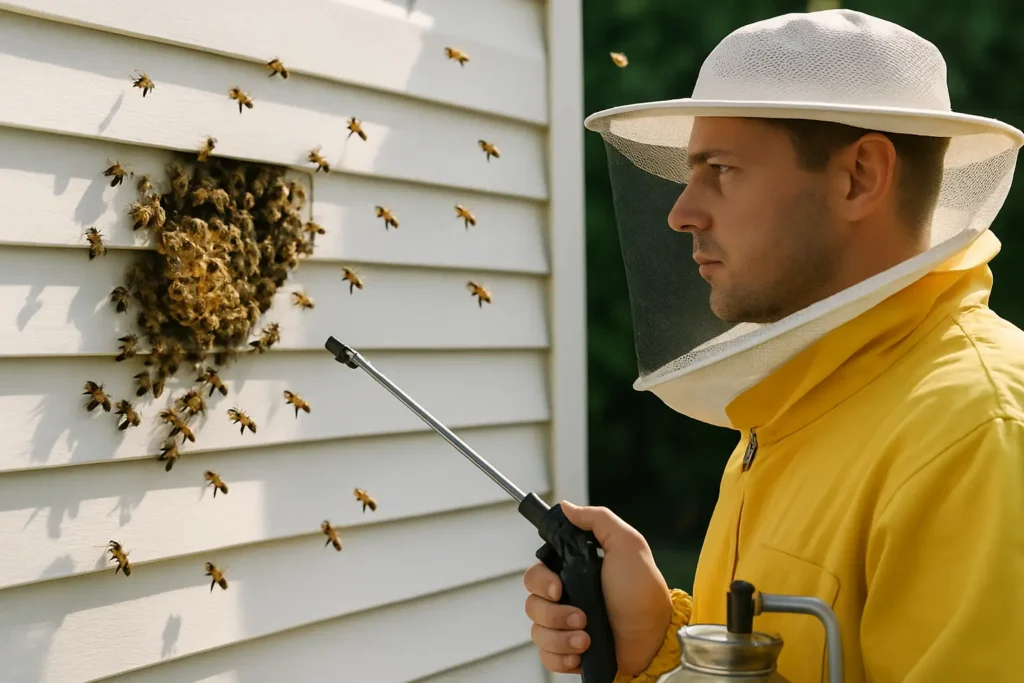
When a colony outgrows its space, the old queen leaves with a large group of worker bees to start fresh somewhere else. They temporarily gather in a cluster – on a branch, a fence post, a car bumper, or the side of a building – while scout bees search for a suitable new cavity.
Here’s what homeowners often notice: swarms can look dramatic, but the bees usually seem oddly calm. That’s not your imagination. During a swarm, bees are not defending stored honey or brood. Their “priority list” is travel and survival, not territorial protection.
It depends on conditions, but many swarms move along within a day or two. That said, timing matters. A swarm that finds a nearby wall void or attic can become an established colony quickly.
If you’re not sure whether you’re seeing a swarm or an established hive, treat it as a safety issue anyway: keep distance, keep pets and kids away, and avoid vibrations like lawn equipment near the cluster.
Established colony behavior: predictable traffic and strong site loyalty
Once bees move into a cavity, their behavior shifts.
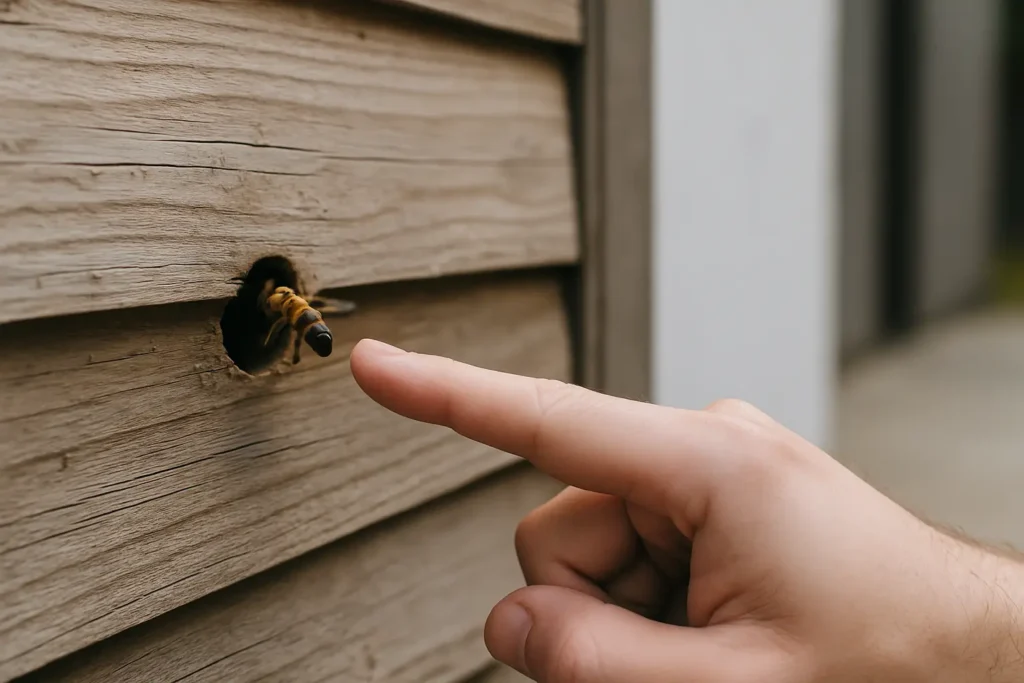
You’ll often see consistent “commuter” traffic: bees flying in and out of one or two specific entry points. The flight path becomes more defined over time, especially on warm, sunny days. If the colony is in a wall, you may also notice a faint honey-like scent, sticky residue, or dark staining near the entrance – not always, but these can be clues.
As the colony settles in, it becomes more defensive about that location. Defensive doesn’t mean “aggressive by default.” Honey bees are not looking for trouble. But they will protect brood and food stores if they feel threatened.
Common triggers for defensiveness include mowing, leaf blowing, construction noise, tapping on walls, or anyone standing directly in the flight path. Even outdoor lighting can affect navigation at dusk, causing bees to collect around fixtures and windows.
Foraging and orientation: why bees “suddenly” appear
One of the most misunderstood moments is when a homeowner says, “They weren’t here yesterday.” Sometimes that’s true – but sometimes the bees were there, and the activity just became visible.
Worker bees forage heavily when weather and blooms line up. A nearby citrus bloom, a flush of landscape flowers, or a neighbor’s blooming tree can increase bee traffic across an entire block.
You may also see young bees performing orientation flights. They hover and face the hive entrance, making short looping flights as they memorize landmarks. To an untrained eye, this can look like a surge in activity or “bees attacking the house,” when it’s often bees learning their address.
Natural bee behavior understanding means recognizing that more bees outside doesn’t always mean a new infestation. It can also mean a healthy colony nearby doing what healthy colonies do.
Communication and “why they keep coming back”
Bees don’t wander randomly. They communicate.
When a forager finds a good food source, she can recruit others using scent and movement back at the colony. That same principle applies to nesting opportunities. Scout bees assess cavities and share that information. A sheltered void with a small entrance, warmth, and dryness is very attractive.
This is why prevention is not just caulk and hope. It’s identifying the actual entry points, understanding how bees locate and reuse them, and addressing the conditions that made the site appealing.
If a colony was removed but leftover comb remains in a wall, the lingering scent can attract pests and sometimes future bee interest. That’s also why a true solution usually includes both removal and repair.
What defensive behavior looks like (and what to do)
Homeowners often ask how to tell if bees are “mad.” There are a few practical signs.
If bees are calmly coming and going and largely ignoring people at a distance, that’s usually normal. If bees begin bumping your face or hair, following you for several yards, or you hear a sudden loud increase in buzzing near the entrance, you’re likely too close to a defended zone.
It depends on the colony and the situation, but the safest response is simple: increase distance, move indoors, and avoid swatting. Swatting can escalate defensive behavior, and it can put you at greater sting risk.
If someone is allergic, treat any stinging incident seriously and follow their medical plan. If you have reason to believe Africanized honey bees could be involved – which can occur in parts of Southern California – give extra space and prioritize professional help quickly.
Why humane removal aligns with how bees actually live
A bee colony is not just a pile of insects. It’s a living system built around brood rearing, temperature control, food storage, and a queen that anchors the colony’s organization.
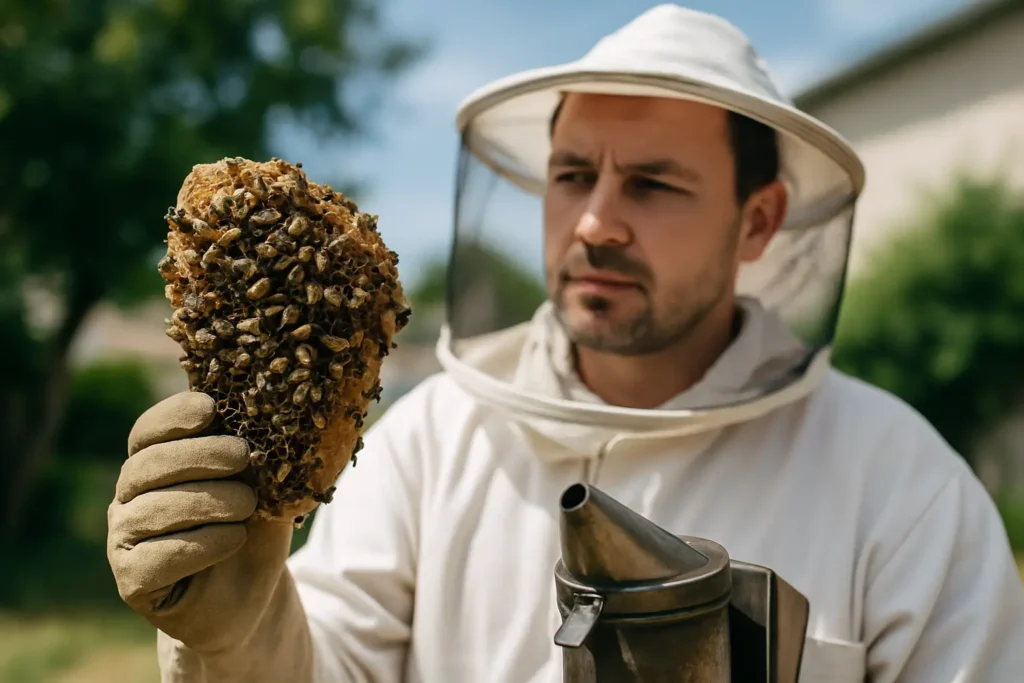
Humane removal tries to preserve that system instead of destroying it. That typically means removing the bees alive, relocating them to a managed setting, and dealing with the comb and cavity so your home stays protected.
There is a trade-off here. Live removal and relocation is more involved than a quick spray. It can require opening a wall or soffit, safely extracting comb, and then repairing entry points. But that effort is what prevents repeats and helps restore peace and home in a way that’s better for both people and pollinators.
If you’re looking for an ethical, service-based approach in Southern California, Eli the Bee Guy focuses on live bee removals, full hive extractions, relocation to vetted apiaries, and entry-point repairs designed to prevent re-occupation.
What you can safely observe before calling for help
You don’t need to get close to gather useful information. From a safe distance, pay attention to patterns.
If bees are clustered in a hanging mass and not entering a structure, it’s likely a swarm. If they are consistently entering and exiting a gap in your home or building, it’s likely an established colony.
Also notice the time of day. Heavy traffic mid-day with steady in-and-out movement points to a working colony. A swarm can appear suddenly and may shift position as scouts guide them.
Finally, listen to your building timeline. Recent roof work, fascia repairs, or attic vent changes can create new gaps. Bees don’t need much space to enter – small openings can be enough.
Why “waiting it out” sometimes works – and sometimes backfires
It depends on what you’re dealing with.
Waiting can be reasonable for a true swarm that is resting temporarily in a tree away from people. Often, it will move on.
Waiting is usually a mistake for a colony inside a wall, attic, or chimney. As weeks go by, the structure fills with comb and stores. Removal becomes more complex, and the chances of secondary problems increase, like honey seepage, odors, or other pests being attracted to the site.
The key is accuracy. Natural bee behavior understanding is what helps you choose patience in the right scenario and fast action in the right scenario.
The most respectful outcome is also the most practical
Most homeowners want the same end result: safe people, a usable property, and no repeat bees in the same spot.
The best way to get there is to work with bee biology instead of fighting it. When you recognize whether you’re seeing travel behavior, nesting behavior, or defensive behavior, you stop guessing. You can respond calmly, protect anyone at risk, and choose a humane solution that addresses the colony and the conditions that invited it.
If there’s one mindset that keeps situations from turning into emergencies, it’s this: give bees credit for being consistent. Their behavior is rarely random. When you learn what it’s saying, you can make decisions that bring peace back to your home – and send the bees to a better one.