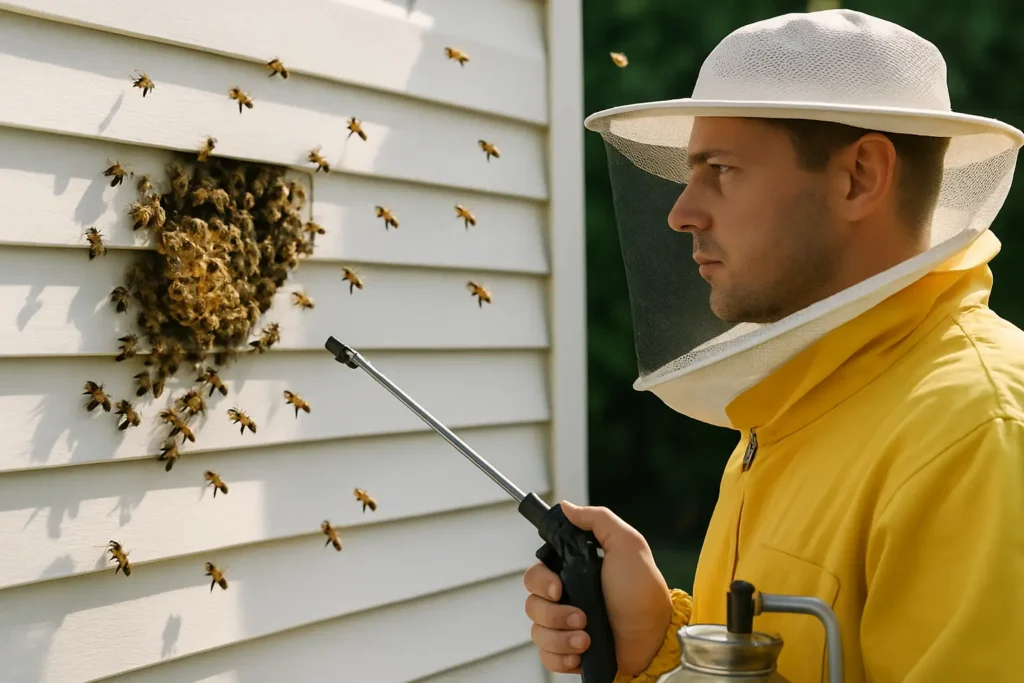
You patch a tiny gap near the eaves. A week later, the buzzing is back – same wall, same spot, same sinking feeling. In Southern California, that pattern is common because bees are excellent at finding reliable shelter, and many “quick fixes” leave the real problem untouched. If you want the kind of peace and home restored that lasts, you need to think beyond getting rid of the bees you can see.
Permanent bee removal solutions are less about a single tactic and more about completing the whole chain: identifying the colony, removing the entire hive structure, cleaning and repairing what attracted them, and blocking every practical re-entry point. Done right, the bees are rescued and relocated, your structure is protected, and you stop the cycle of repeat occupation.
What “permanent” really means with bee problems
A permanent outcome is not the same as “bees will never fly near my building again.” Bees forage across miles. What you can control is whether your property remains a suitable nesting site.
A lasting solution means three things: the colony is fully removed (not just dispersed), the comb and honey residue are addressed (so your walls do not keep advertising “home” to the next swarm), and the access route is repaired so scouts cannot re-establish a foothold. If any one of those steps is skipped, the chances of a repeat problem jump.
There is also an important nuance: sometimes the original bees do not come back – different bees do. Old scent, leftover comb, and a warm cavity can draw new scouts within weeks, especially during swarming season.
Why “spray and pray” fails, especially in walls and attics
Homeowners are often sold on the idea that repellents, foams, or insecticide dusts are “one and done.” They can be fast, but fast is not the same as finished.
If a colony is inside a wall, spraying at the entrance may kill some bees while leaving comb behind. That comb can melt in heat, seep into drywall, stain ceilings, and invite ants, roaches, rodents, and moths. Even if activity looks lower for a short time, the cavity can remain attractive – and structurally messy.
There is also a safety angle. Agitated bees defend their hive. Improper treatments can push them into living spaces through light fixtures, vents, and wall voids. For homes with children, pets, tenants, or anyone with a sting allergy, that risk is not worth it.
Permanent solutions usually require physical removal and repair, not just chemical interruption.
Permanent bee removal solutions that work long-term
Real permanence comes from doing the unglamorous work that can’t be skipped. The exact approach depends on where the bees are, how long they have been there, and what the structure allows.
Live removal and full hive extraction
When bees are established in a cavity, the gold standard is a full hive extraction. That means accessing the hive, removing the bees, and taking out comb and honey stores – not leaving them to rot inside the structure.
This step is where experience matters. Access points are chosen to minimize damage while still allowing complete removal. The goal is to remove the colony intact when possible, keeping the queen with the bees so they can be safely relocated.
If the bees are a swarm clustered outside (tree branch, fence, patio cover), live removal can often be straightforward. But if they have already moved into a wall or roofline, the work is more involved and permanence depends on fully addressing what is hidden.
Ethical relocation to vetted apiaries
A “permanent” solution for your property does not have to mean a dead colony. Relocation is a practical win-win when it is done correctly. The bees continue natural behaviors in an appropriate environment, and your home is no longer their nesting site.
The key is ensuring they are moved to places equipped to manage them responsibly. A relocation plan that simply dumps bees “somewhere” is not fair to the bees and does not always prevent them from drifting back into neighborhoods where cavities are abundant.
Comb removal, honey cleanup, and odor control
Bees build comb for brood and food storage. When that comb is left inside a wall, it becomes a lasting attractant.
Removing comb reduces the scent trail that tells future scouts, “This worked before.” It also reduces the chance of secondary infestations and the kind of damage that leads to expensive repairs later. Cleanup is rarely anyone’s favorite part of the job, but it is one of the main reasons permanent bee removal solutions actually stay permanent.
Entry-point repairs that stop re-occupation
Bees do not need much room. Gaps around fascia boards, warped siding, roof returns, utility penetrations, and old vents can be enough.
Repair is the difference between “we got lucky” and “we solved it.” Sealing is most effective when it is based on how bees actually moved in, not a guess. If you only close the visible hole, scouts may find the next gap a foot away. A professional approach focuses on the pathway and the cavity access points, then reinforces those areas so the structure stops presenting easy nesting options.
Property-side prevention: reducing future nesting appeal
Not every prevention step is structural. Some are behavioral and seasonal.
If you regularly see swarms in spring, keeping an eye on exposed cavities and addressing wood rot early helps. Maintaining screens, repairing loose trim, and checking attic vents before swarming season can make your property less attractive. On commercial properties, routine building envelope inspections are especially valuable because small gaps become big invitations over time.
What to do right now if you suspect a hive
Timing matters, but so does not making the situation worse.
If you see consistent bee traffic in and out of a crack, that suggests an established colony, not a temporary swarm. Keep people and pets away from the flight path, avoid blocking the entrance (that can drive bees indoors), and avoid vibrating tools near the area. If anyone in the home has a history of severe reactions, treat it as urgent and prioritize professional help.
If it is a swarm resting on a branch or exterior surface, it may move on within a day or two. But swarms can also decide to settle into a structure quickly. A safe removal early can prevent a small situation from turning into a wall hive that requires opening and repair.
DIY vs professional help: where “it depends” is real
There are cases where a homeowner can handle prevention: replacing a broken vent screen, caulking a known gap, or repairing trim as part of normal maintenance. Those steps are useful after a hive is removed and can lower the odds of future nesting.
But once bees are inside a structure, DIY attempts tend to trade short-term relief for long-term problems. The biggest trade-offs are safety (stings, defensive behavior), incomplete removal (leaving comb and attracting more pests), and property damage (opening the wrong area or sealing the wrong place).
Professional live removal also brings a humane advantage. Instead of treating bees as a disposable nuisance, the colony can be rescued and placed where it can thrive.
How to recognize a truly permanent solution (before you hire)
Homeowners and property managers often ask the right question: “How do I know this won’t happen again?” No one can promise nature will never return, but you can absolutely tell whether a provider is thinking long-term.
A permanent-minded approach includes an inspection that identifies the entry route, a plan for full comb removal when the bees are established in a cavity, and a clear repair strategy to close and reinforce access points. You should also hear a calm explanation of what will happen to the bees, where they will go, and what the property will look like afterward.
Be cautious of anyone who dismisses structural repair as unnecessary or who promises a chemical-only approach will solve a wall hive permanently. If comb is left behind and the entry point remains, your odds of a repeat issue stay high.
What permanence looks like for Southern California homes and buildings
Our region has long warm seasons, plenty of ornamental landscaping, and a steady supply of older structures with small gaps that develop over time. That means prevention is not a one-time event, it is a maintenance mindset.
For many properties, the most permanent result comes from pairing humane removal with targeted repair and a quick check-up of the surrounding areas where bees commonly probe. It is also wise to consider the property type. Apartments and commercial buildings often have repeating architectural features – identical vents, trim lines, and roof details – so a “one entrance” problem can indicate multiple similar vulnerabilities.
If you want help with a humane, full-scope approach – live removal, complete hive extraction when needed, relocation, and entry-point repair to prevent re-occupation – you can reach out to Eli the Bee Guy.
Peace and home restored is not a slogan when the work is done thoroughly. It is what happens when the bees are rescued, the structure is respected, and your property stops offering the next swarm an open door.