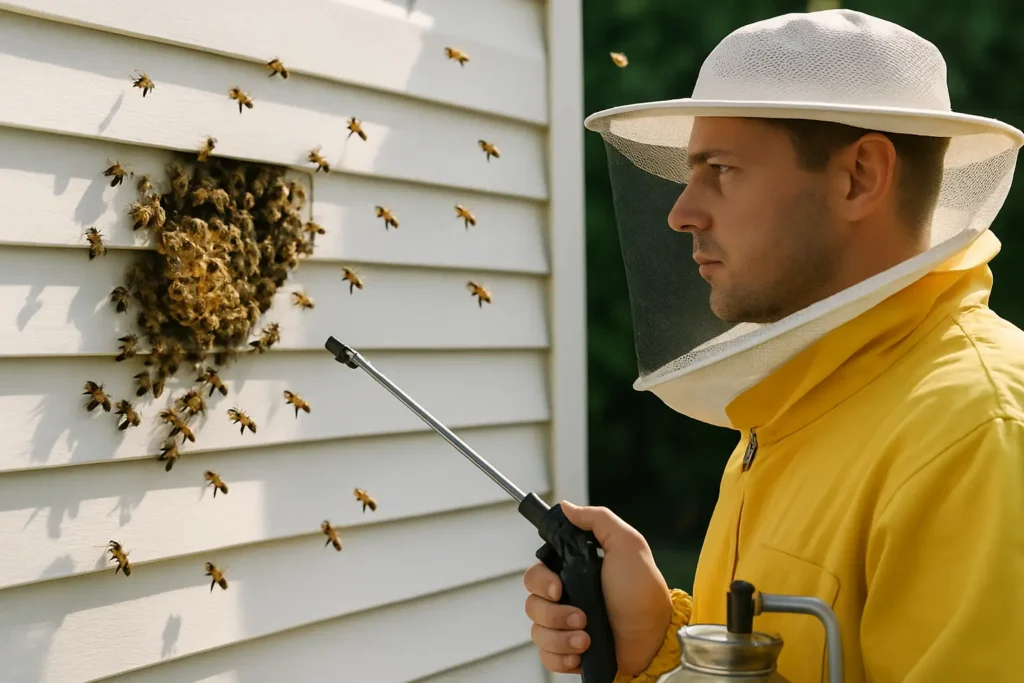
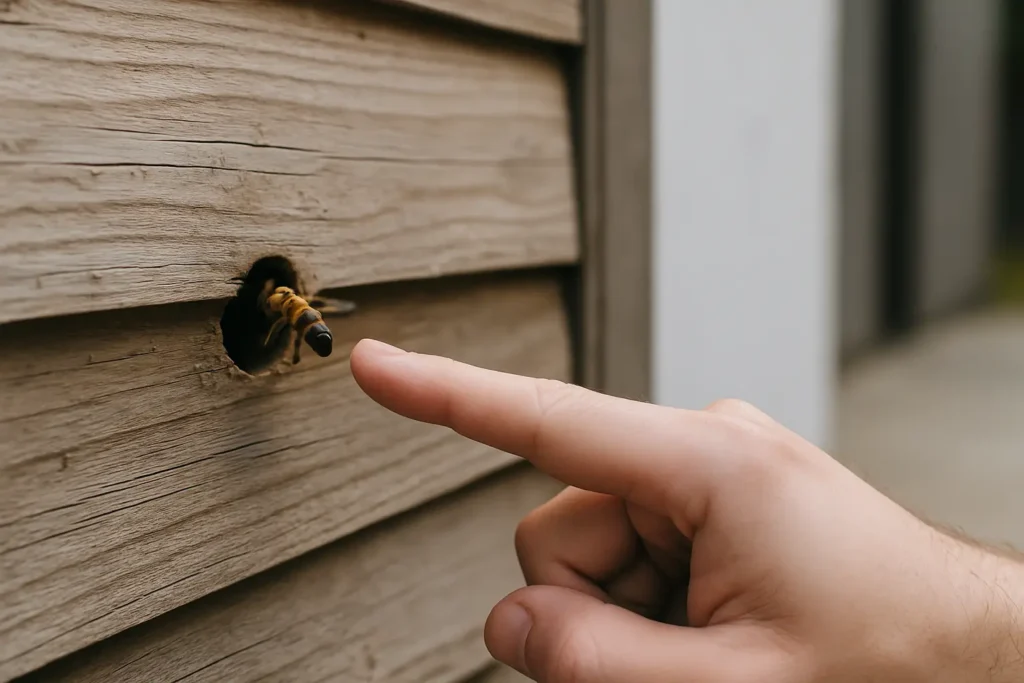
A bee problem rarely starts with “bees everywhere.” It usually starts with one overlooked crack where a steady line of workers begins to commute—quietly, efficiently, and often out of sight until there’s a lot of buzzing behind a wall.
That’s why entry-point bee prevention methods matter. Not because bees are “bad,” but because a home or business isn’t the right place for a colony to build. The goal is peace and home restored for you, and a safe outcome for the bees.
Why bees choose certain entry points
Honey bees aren’t trying to break in. Scout bees search for a protected cavity that stays dry, holds warmth, and has a defensible opening. Southern California buildings offer plenty of options: stucco weep screeds, roofline gaps, aging fascia boards, and unprotected vents.
Once scouts approve a spot, the colony commits. At that point, “quick fixes” like spraying or blocking a hole can backfire—bees may find another exit into the structure, and if there’s brood and honey inside, you can end up with odors, stains, or other pests moving in after the bees die or abandon the comb.
Entry-point bee prevention methods that actually hold up
The best prevention isn’t one product or one afternoon. It’s a combination of removing the attraction, closing the access, and keeping the building breathable and code-appropriate. Here’s what that looks like in real life.
Start with observation, not panic
Before you seal anything, spend a few minutes watching. Are bees consistently entering and exiting one spot, especially during warm daylight hours? That’s a strong sign of an active colony inside a void. If you see a cloud of bees clustered on a branch, that’s more likely a swarm that’s resting temporarily.
This distinction matters because prevention and repair should come after proper removal. Sealing an active entrance can trap bees inside, increasing the chances they’ll show up somewhere you don’t want them—like an interior light fixture or a wall outlet.
Seal the “usual suspect” gaps—carefully
Most structural entry points are small: 3/8 inch can be enough for bees. The trick is sealing in a way that lasts through heat, sun exposure, and building movement.
For stucco and siding transitions, high-quality exterior sealant can work when the gap is stable and dry. Around rooflines and fascia, repairs often need more than caulk—rot or warping has to be corrected or the gap reopens. Where different materials meet (wood to stucco, metal flashing to wood), expect expansion and contraction; flexible sealants and properly fastened flashing do better than brittle patch jobs.
If you’re not sure whether a gap is “inactive,” treat it as suspect. It’s better to confirm first than to create a bigger problem by sealing the wrong opening.
Upgrade vents and screens, don’t “block airflow”
Bees commonly enter through attic vents, gable vents, roof vents, and bathroom exhaust terminations. The right prevention here is exclusion that still lets the building breathe.
Metal screening (hardware cloth) with an appropriate mesh size is often effective because it resists chewing and weathering. The installation matters as much as the material: screens need to be secured so they can’t pull loose in high winds, and they should be framed or fastened cleanly so edges don’t curl.
Dryer vents and exhaust outlets need a functional damper. If a vent cover is broken or stuck open, it’s an invitation. But “stuffing” vents with foam or other fillers can create moisture problems and may violate building requirements.
Address roofline and eave vulnerabilities
In Southern California, heat and sun can age roofing components faster than people expect. Tiny separations at eaves, missing bird stops, gaps near returns, and poorly fitted flashing can become reliable entry points.
If you’ve had roof work done, it’s worth inspecting the edges afterward. Not because roofers are careless, but because bee-sized gaps can be too small to notice unless you’re looking for them. A careful, methodical perimeter check—especially where the roof meets stucco or fascia—catches a lot.
Don’t ignore “attractants” around the structure
Prevention isn’t only about holes. Bees are drawn to certain conditions, and reducing those can lower the odds of scouts focusing on your property.
Old comb is a big one. If a previous colony lived in a wall void and the comb wasn’t removed, that scent can keep calling bees back season after season. Another attractant is standing water with minerals—bees collect water for cooling and hive functions. Leaky irrigation, dripping hose bibs, or consistently damp spots can become bee traffic zones.
Fruit trees can also draw bee activity (which is often beneficial outdoors), but when overripe fruit drops and ferments near a building, it can increase interest around doors, patios, and utility penetrations. Simple cleanup and keeping bins closed helps keep the activity where it belongs—out in the yard, not under the eaves.
Use timing to your advantage
In our region, bee activity ramps up during warmer stretches and spring swarm season. That doesn’t mean you should seal blindly during peak activity. It means routine exterior maintenance—screens, sealants, fascia repairs—should be scheduled before problems start.
If you manage commercial properties, add “bee exclusion check” to seasonal maintenance alongside roof inspections and HVAC checks. It’s a small line item compared to opening walls later.
When prevention becomes repair: the re-occupation problem
Many property owners learn the hard way that “removal” and “prevention” are different jobs. Even after bees are safely taken out, the original entry point often still exists. If it’s left open, scouts can find it again.
True prevention includes:
- Closing the exact entrance bees used (not just nearby gaps)
- Making sure no alternate exits remain open (bees often have more than one)
- Handling any scent issues from residual comb when applicable
If you’re dealing with a known prior hive location, that last point is especially important. Otherwise, you may stop today’s bees and still get tomorrow’s scouts.
DIY vs. professional help: where the line is
Some entry-point bee prevention methods are reasonable for a handy homeowner: replacing torn screens, installing vent covers, sealing small, clearly inactive cracks during the off-season, and keeping vegetation trimmed away from rooflines.
But there are situations where professional help is the safer and more humane option:
If bees are actively using an entrance
A consistent stream in and out usually means a colony inside. This is not the moment to seal, spray, or set off anything “repellent.” Besides the risk of pushing bees into living spaces, chemical approaches can harm non-target pollinators and often fail to solve the underlying issue.
If the entrance is high, steep, or requires opening structures
Roof peaks, second-story eaves, and attic work add fall risk and electrical hazards. When removal requires cutting into stucco, soffits, or drywall, the job becomes as much construction as it is bee work.
If allergies or high-traffic areas are involved
For families with sting allergies or properties with customers, tenants, or employees, speed and control matter. Prevention should reduce risk—not add to it with an uncertain DIY attempt.
If you need humane removal followed by entry-point repairs that prevent re-occupation, that’s exactly the kind of end-to-end work Eli the Bee Guy focuses on across Southern California counties. You can learn more at https://elithebeeguy.com/.
What “humane prevention” means in practice
It’s fair to ask: can prevention be ethical? Yes—when it’s done with respect for the bees’ role in the environment and without creating unnecessary suffering.
Humane prevention means you don’t poison a colony in a wall and walk away. It means you don’t trap bees inside a void without an exit. And it means you prioritize relocation to responsible apiaries when a colony is already established.
It also means setting realistic expectations. Exclusion doesn’t guarantee you’ll never see a bee on your property—bees belong in our landscapes. The goal is to stop nesting in structures and prevent repeat infestations.
A simple way to think about your next step
If you’re seeing occasional bees near flowers, enjoy them from a distance—they’re doing important work.
If you’re seeing repeated, purposeful traffic into a crack, vent, or roofline gap, treat it like what it is: a structural access issue that can grow quickly. Get the bees handled safely first, then close the entry point the right way so both your building and the bees can move forward.
Peace is possible here—quiet walls for you, and a better home for the bees somewhere they’re meant to thrive.