Warm spring afternoon, and there's a huge shiny black bee hanging in the air by your patio cover like it owns it. Then you spot a perfectly round hole in the wood with a little pile of sawdust under it. Odds are you've met a carpenter bee.
Short answer: Carpenter bees are big native bees that live alone and bore round, half-inch holes into bare, unpainted wood like redwood and cedar to raise their young. The damage is usually minor. You can stop them without killing them by painting or varnishing exposed wood, switching to hardwoods or non-wood materials, and plugging the empty holes.
Which carpenter bees live in Southern California?
California has three carpenter bee species, according to the late UC Davis bee expert Robbin Thorp, writing for the UC Davis bee biology program. You'll find all three in parts of Southern California:
- Valley carpenter bee (Xylocopa varipuncta): the big one, about the size of a queen bumble bee. Females are all black, with dark wings that flash violet in the sun. The males look nothing like them. They're fuzzy and golden or buff colored, with green eyes, and a lot of people don't realize the two are the same species.
- Xylocopa californica: nearly as big, with a bluish metallic shine. It lives in the foothills around the Central Valley and in Southern California's Transverse Ranges, including the Los Angeles area.
- Xylocopa tabaniformis orpifex: the smallest of the three, but still a lot bigger than a honey bee. Females are black, and males have bright yellow markings on the face.
Carpenter bees don't live in big colonies the way honey bees do. Each female builds and stocks her own nest.
What are the signs of carpenter bees?
Carpenter bees leave signs that are pretty easy to recognize. Look for:
- Perfectly round holes about 1/2 inch across, often on the underside of eaves, fascia boards, fence rails, decks, pergolas and patio covers
- Fine sawdust piled on the ground or on whatever is below the hole
- Stains on the wood around and below the entrance
- A tunnel that turns just inside the entrance and runs along the grain
- Big bees hovering near the wood, and sometimes zooming right at your face
They really like weathered, unpainted wood. UC IPM notes that they prefer sound wood without paint or bark, attack softwoods like redwood, cedar and Douglas fir, and generally avoid most hardwoods. Around here, that's an awful lot of fences and patio covers.
How much damage do carpenter bees do?
Carpenter bees don't eat wood the way termites do. They chew out tunnels to lay their eggs in. According to the UC IPM Pest Note on carpenter bees, a typical nest tunnel is about 1/2 inch wide and 6 to 10 inches deep, divided into cells that each hold an egg and a ball of pollen.
The problem is that they like to reuse old tunnels and make them bigger, and several bees may share one entrance. Over many years, tunnels can stretch as far as about 10 feet into a timber. UC IPM says carpenter bee damage to structures is usually minor, but heavy, repeated nesting can weaken wood. Open holes can also let moisture, wood-decay fungi and other insects get in.
It's worth dealing with, but it's not usually a "call someone tonight" emergency.
Carpenter bees vs. bumble bees vs. honey bees
People mix carpenter bees up with bumble bees all the time, and both get confused with honey bees. Here's a quick way to tell them apart:
| Carpenter bee | Bumble bee | Honey bee | |
|---|---|---|---|
| Abdomen | Shiny, mostly bare on top | Fuzzy all over | Fuzzy, golden-brown with bands |
| Size | Large | Large | Much smaller |
| Lifestyle | Solitary | Small colonies | Large colonies of thousands |
| Nest | Tunnels bored into wood | Existing cavities, often old rodent nests | Wax honeycomb in cavities like walls, trees and boxes |
| Damage to homes | Holes in exposed wood | Rarely an issue | Comb, honey and bees inside walls, roofs and attics |
The easiest way is to look at the rear end. A bumble bee is hairy from head to tail, and a carpenter bee's abdomen is shiny and mostly bare on top.
Do carpenter bees sting or bite?
Rarely. Male carpenter bees can't sting at all, because they don't have a stinger. They are territorial, though, and they'll hover in your face or dive-bomb you to check you out. It's all bluff.
Females do have a stinger, but UC IPM says they sting only when provoked or handled roughly. If you're just walking by the patio, you have very little to worry about.
What about biting? Carpenter bees chew wood with their jaws to dig their tunnels, but they aren't known to bite people. That noise in the fence post or fascia board is a female drilling. She isn't getting ready to bite anybody. As always, if anyone has trouble breathing or swelling of the face or throat after any sting, call 911.
How to get rid of carpenter bees without killing them
Carpenter bees are pollinators, and UC IPM says insecticides generally aren't recommended for them under most conditions. Prevention is what works, and it works best before nesting season gets going in spring:
- Paint or varnish exposed wood. Carpenter bees go for bare, unfinished wood, so keep exposed surfaces painted or varnished and stay on top of it. A UC Davis extension note recommends oil-based paint or polyurethane and warns that stains alone don't reliably prevent damage.
- Fill cracks and dents in the wood, since those make easy starting points.
- Plug old holes, but at the right time. Fill unused holes with steel wool and caulk, then repaint or varnish, only after the adults have come out. Wait until you stop seeing bees use the hole, because sealing it with bees still inside just traps them.
- Cover rough spots. Wire screen or metal flashing over exposed timber ends and rough areas makes them a lot less inviting.
- Pick materials they don't like. For new projects or repairs, use hardwoods on exposed outdoor parts where you can. Non-wood materials like aluminum and vinyl aren't damaged at all, and pressure-treated wood is another option.
If you like having pollinators around, you could leave an old untreated stump or snag in a back corner of the yard. UC Master Gardeners suggest exactly that to support carpenter bees, as long as it's away from the house.
Is it carpenter bees, or a honey bee hive in your wall?
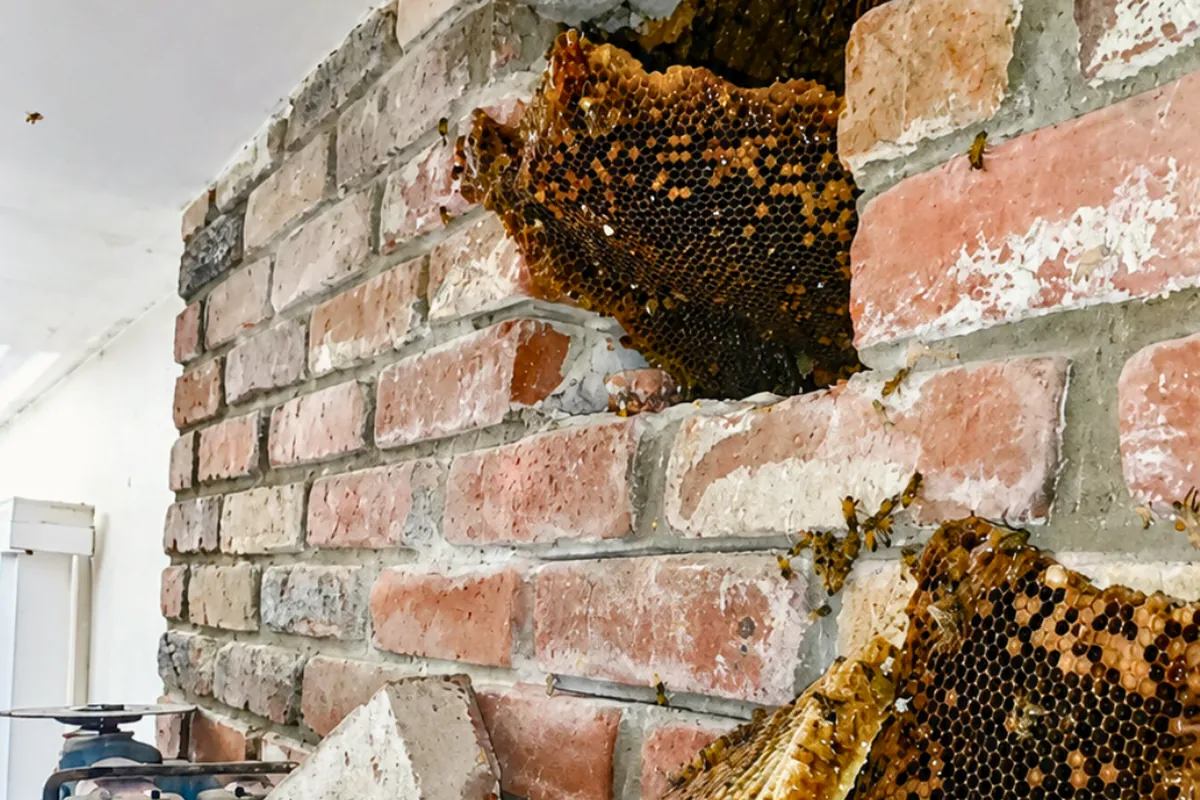
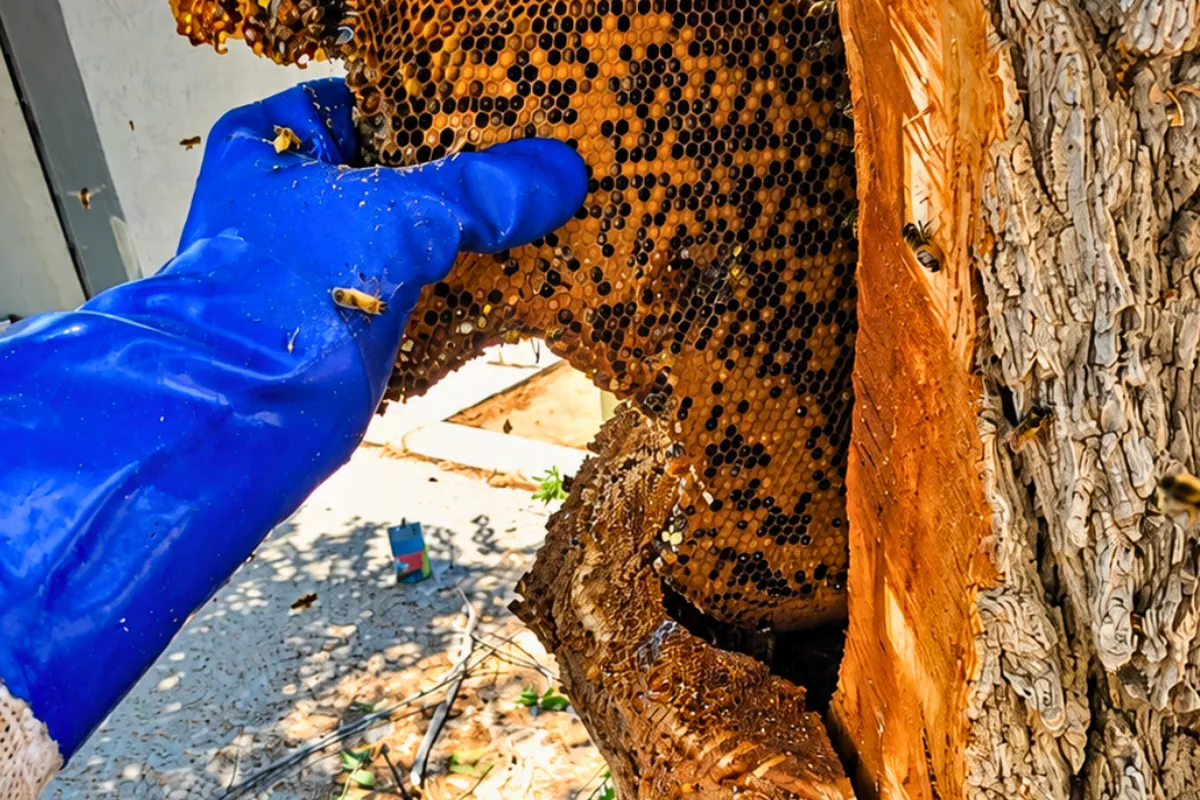
People get these mixed up, and they call for different fixes. Carpenter bees drill their own holes, and you'll usually see one or a few big bees at a time. Honey bees never drill. They move into a gap that's already there, like a crack in the stucco, an opening under the roofline or a hole around a pipe, and build wax honeycomb in the cavity behind it.
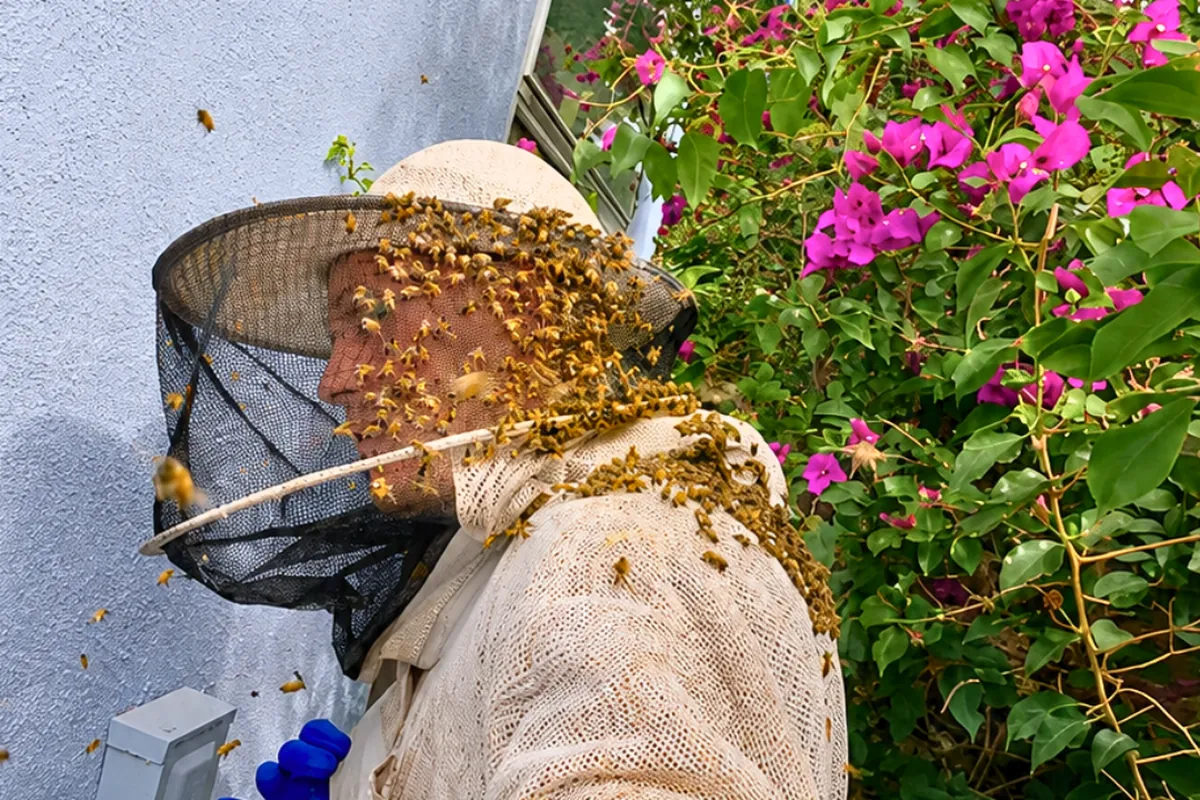
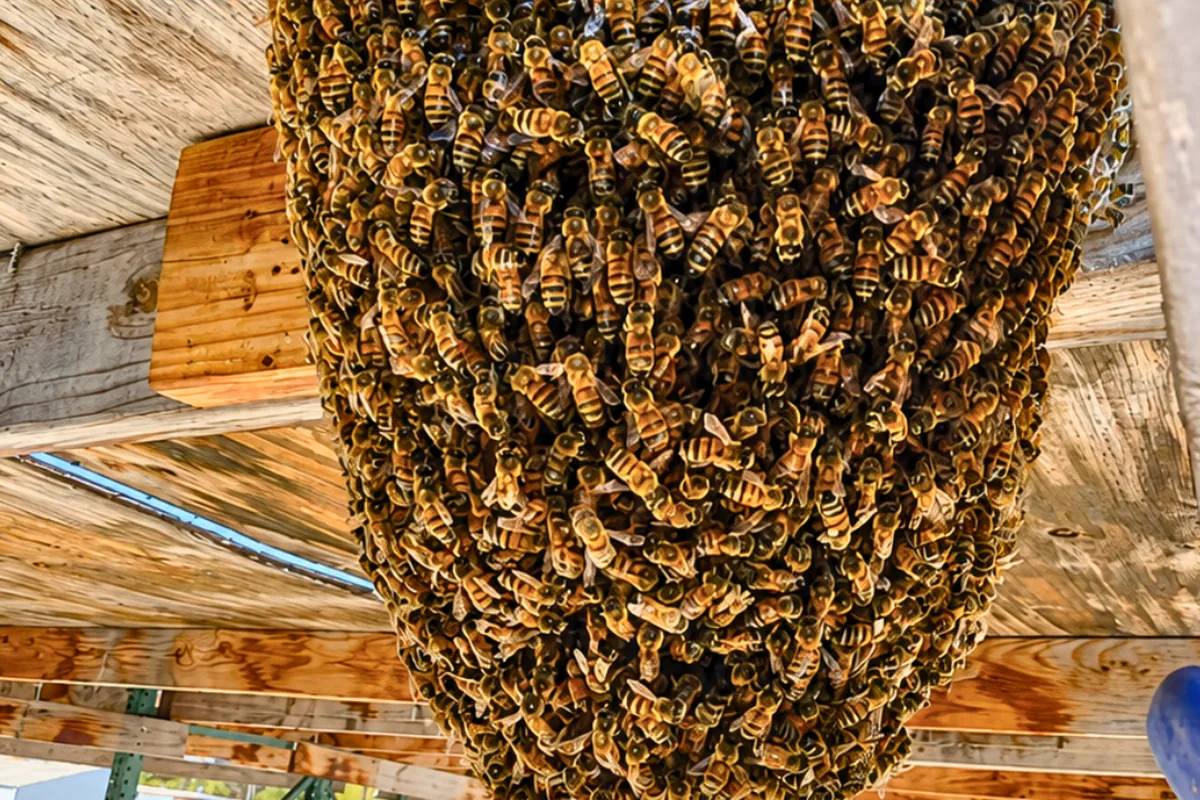
If you're seeing a steady stream of smaller, fuzzy, golden-brown bees going in and out of one opening, or you hear a humming sound inside a wall, it's probably a honey bee colony. That's a job for live bee hive removal, where the bees and all the comb come out and the bees are relocated to a local beekeeper. Paint won't help with that one. For more on honey bees around the house, see my residential bee removal page.
Need a hand?
I don't offer carpenter bee removal. I'm still happy to come out for a free inspection, tell you whether it's carpenter bees, honey bees or something else, and give you a straight answer on what to do next. If it's honey bees, I'll remove them alive with no chemicals. I help homeowners in Riverside, Claremont and all across Orange County, the Inland Empire and LA County. Call me at (626) 487-6052 or request a free quote.
Frequently asked questions
Can carpenter bees bite you?
When are carpenter bees most active in California?
Do carpenter bees come back to the same holes?
Are carpenter bees good pollinators?
Are carpenter bees as bad as termites?
Can a carpenter bee hurt my dog or kids?
Like these guides? Add Eli the Bee Guy as a preferred source on Google to see more of them in your search results.